


Table of Contents
-
Use An AI Acceptable Use Policy Template To Create Operational Control
-
Advanced Tools For Detecting Shadow AI Risks Across Your Environment
-
AI Business Email Security Protects Client Communications And Approval Workflows
-
AI Acceptable Use Policy Examples Should Define Real Team Workflows
-
A Generative AI Acceptable Use Policy Defines How Your Team Protects Sensitive Data
-
An AI Acceptable Use Policy For Employees And Managers Works Best When Responsibility Is Shared
-
What Should An AI Acceptable Use Policy Include Before Broader Adoption?
-
Shadow AI Risks And Mitigation Strategies Must Scale With Growth
-
Shadow AI Compliance Risks Appear In Vendor And Client Data Workflows
Staff are already using public AI tools to summarize contracts, draft client emails, troubleshoot spreadsheets, and analyze exported reports. A 2024 Salesforce survey found 55% of employees used AI tools their organization had not approved and this is Shadow AI.
An AI acceptable use policy turns shadow AI into documented decisions for approvals, data handling, client confidentiality, compliance, security controls, and repeatable workflows.
Cameron Rose, Cybersecurity and Compliance Analyst at Protek, notes: “Start with the data employees touch every day, then define approved tools, processes, and reporting paths before AI reaches clients or regulated records”
Use An AI Acceptable Use Policy Template To Create Operational Control
A generic AI acceptable use policy template gives you a starting point. The value comes from turning that language into standards your staff can follow across CRM records, shared drives, invoices, tickets, and approvals.
Protek builds your policy through its AI readiness program. First, employees are surveyed on how they use AI today, and Microsoft 365 Copilot activity is reviewed. Then those findings shape a policy that reflects the tools and workflows your team already has:
-
Approved AI tools: Name the systems staff can use, starting with the ones they already depend on.
-
Prohibited data types: Keep client files, payroll records, and credentials inside approved systems.
-
Review before sending: Require approval for client-facing output.
-
Role-based access: Match AI access to job responsibilities.\
-
Reporting path: Route questionable use through a documented ticket.
Advanced Tools For Detecting Shadow AI Risks Across Your Environment
An estimator uploads a bid file to an unapproved AI app. A manager links cloud storage to summarize folders. Leadership cannot protect data it cannot see.
Advanced tools for detecting shadow AI risks include monitoring, log review, DNS filtering, endpoint visibility, and cloud application discovery. With 24/7/365 IT Monitoring, log management, dark web monitoring, and device visibility, Protek helps trace where AI touches corporate data before it affects approvals, invoices, customer records, or compliance. The 2026 Verizon DBIR found 45% of employees regularly use AI on corporate devices, with 67% using non-corporate accounts.
Shadow AI Security Risks Affect Daily Workflows
Shadow AI security risks sit close to tickets, approvals, invoices, and client messages. Shadow AI is now the third most common non-malicious data leakage activity, and AI usage has surged from 15% to 45% of employees in a single year.
-
Exposed client data: Contract terms enter tools outside approved controls.
-
Unverified outputs: Incorrect summaries slow decisions.
-
Account compromise: Fake vendor emails disrupt payment workflows.
-
Unmanaged browser tools: Extensions bypass software review.
-
Compliance evidence gaps: Audit trails miss data movement.
More Ways To Control IT Risk
AI Business Email Security Protects Client Communications And Approval Workflows
AI makes phishing cleaner and vendor impersonation more convincing. A payment approval, title update, or client change order needs stronger and even physical verification before anyone clicks, replies, or changes account details.
AI business email security should cover email filtering, identity protection, web browsing security, phishing site blocking, next-generation antivirus protection, and monitoring.
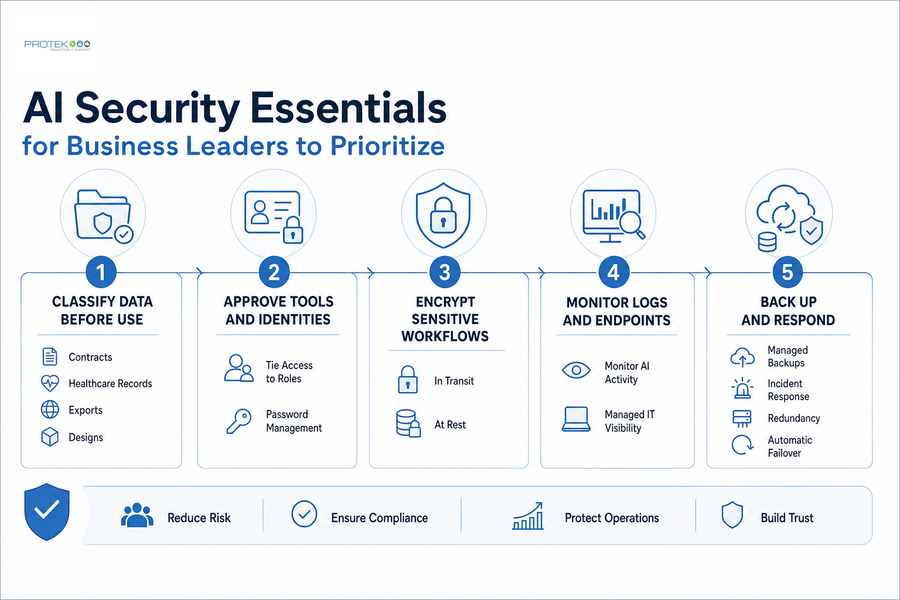
AI Security Essentials For Business Leaders To Prioritize
A report found 78% of organizations lack formal policies for creating or removing AI identities. It also found 92% are not confident legacy Identity and access management (IAM) tools can manage AI and non-human identity risks, while 79% have moderate or low confidence in preventing Non-Human Identity (NHI) attacks, which involve threat actors compromising machine-based credentials, such as service accounts, API keys, OAuth tokens, and CI/CD pipelines, rather than targeting human users.
-
Classify data before use: Label contracts, healthcare records, exports, and proprietary designs.
-
Approve tools and identities: Tie access to roles, password management, and business purpose.
-
Encrypt sensitive workflows: Protect files in transit and storage.
-
Monitor logs and endpoints: Review devices, connections, and application behavior.
-
Back up and respond.:Use managed backups, incident steps, redundancy, and automatic failover.
These AI security essentials for business help keep adoption practical, visible, and aligned with daily operations.
Risks Of Shadow AI In Regulated Operations
Regulated and contract-driven environments need proof that sensitive data is handled consistently. The risks of shadow AI appear when a healthcare record, mortgage package, construction drawing, manufacturing file, or eCommerce customer export moves through an unapproved tool.
Protek helps teams build standardized infrastructure, centralized hardware and software inventory, encryption, role-based access, IT asset management, vendor management, and compliance planning.
AI Acceptable Use Policy Examples Should Define Real Team Workflows
AI acceptable use policy examples should define categories, not bury teams in legal language. Operations can approve meeting summaries, finance can restrict invoice exports, customer service can require review before replies, and field staff can escalate unclear tool requests.
Useful categories include approved uses, restricted uses, prohibited uses, approval workflow, and escalation path.
A Generative AI Acceptable Use Policy Defines How Your Team Protects Sensitive Data
A generative AI acceptable use policy must say what employees can enter, what requires approval, and what stays inside approved systems. Current research found over 4% of GenAI prompts and 20% of uploaded files exposed sensitive corporate data in Q2 2025. The same research found 78% of knowledge workers use third-party GenAI tools despite only one-third of organizations having defined AI usage guidelines.
Keep contracts, customer lists, employee records, financial exports, healthcare records, source files, and proprietary designs inside approved environments with encryption, access management, secure cloud storage, and managed backups.
Run AI As A Managed Program, Not A One-Time Project. A policy written once and filed away goes stale as fast as AI tools change. Protek treats AI governance as an ongoing part of managed IT. Adoption is tracked, policies are kept current, new use cases are added as they prove out, and progress is reviewed at your quarterly business review.
CImplement AI Safely With Protek
Turn AI use into a clear policy, an approved toolset, and a roadmap your team can follow. Protek assesses how your staff use AI today, writes the policy around it, and manages adoption as an ongoing program.
What Are The Risks Of Shadow AI?
What are the risks of shadow AI? The business risk is unmanaged decision-making, untracked tools, and unapproved data movement. One in five organizations reported a breach due to shadow AI, while only 37% have policies to manage AI or detect shadow AI.
The right response is visibility, approved tools, documented policies, and security monitoring that preserve productivity while giving leadership control over files, customer records, approvals, and data access.
An AI Acceptable Use Policy For Employees And Managers Works Best When Responsibility Is Shared
An AI acceptable use policy for employees works best when responsibility is shared. Employees need data rules, managers approve use cases, and IT monitors tools, access, and tickets.
-
Review the policy: Tie rules to client emails and report exports.
-
Inventory active tools: Document AI apps across browsers, desktops, and cloud accounts.
-
Check access levels: Match permissions to roles.
-
Train by scenario: Use invoice, contract, support, and field examples.
-
Report concerns: Route questions through the service desk.
What Should An AI Acceptable Use Policy Include Before Broader Adoption?
Leadership needs clear components before broader AI adoption, especially when 63% of organizations have no AI governance policies to manage deployment or prevent unauthorized use.
An AI acceptable use policy should include ownership, approved tools, data rules, review standards, access controls, monitoring, incident reporting, vendor review, and update cadence.
Protek’s vCIO and Technology Alignment Manager process turns assessment findings into an AI roadmap. Each priority is ranked, each task has an owner, and each initiative has a projected business return. The roadmap connects to asset management, vendor management, and your long-term technology plan.
Shadow AI Risks And Mitigation Strategies Must Scale With Growth
Growth spreads AI exposure across locations, devices, cloud apps, and deadlines. Shadow AI risks and mitigation strategies need to scale with the business.
For multi-site operations, that means standardized infrastructure and centralized inventory. For eCommerce expansion, it means network upgrades and scalable environments. During an office relocation, it means planned cutovers and documented assets. For clean energy reliability, isolated networks, stronger hardware, redundancy, and automatic failover keep operations steadier.
Shadow AI Compliance Risks Appear In Vendor And Client Data Workflows
Shadow AI compliance risks often appear in vendor reviews, data retention, audit trails, confidentiality obligations, and client reporting.
A policy supports compliance work, but it does not replace legal or regulatory judgment. As part of managed IT services, Protek pairs security monitoring, log management, password management, USB lockouts, encryption, and assistance with compliance so records match actual workflows.
AI Security Risks For Small Business And The Next Move
AI security risks for small business are manageable when scattered tool use becomes visible, documented, and secure. Your policy should connect approved AI tools to tickets, access controls, monitoring, backups, and client-facing review steps.
If you want practical help, contact Protek Protek provides proactive IT support, certified local technicians, 24/7/365 IT Monitoring, secure infrastructure, and cybersecurity execution backed by 15 years in business, a 97.6% CSAT score, and an average client retention period of 6½ years.